Search “garage floor coating” or “concrete floor coatings” and you get a wall of products, each sold as the last floor you will ever need. Paint, boxed kits, flake floors, polyaspartic top coats and snap-together tiles all go by garage flooring, but they are not interchangeable, and on a Greater Cincinnati slab the difference usually shows up in the first winter.
This guide lines them up from the cheapest cover to a fully installed epoxy garage floor coating, then covers weather, prep, prices and quotes. For how epoxy is built layer by layer, see our guide to the epoxy garage floor. This page is about choosing.
Why a Garage Slab Is Different
Ohio's residential code puts garage floor slabs in the same group as porches, carport slabs and steps that face the weather, and asks for stronger, air-entrained concrete there than under a basement. Kentucky's code rates weathering as severe in every county. Both want the parking area sloped toward a drain or the door, which is where meltwater and road grime end up.
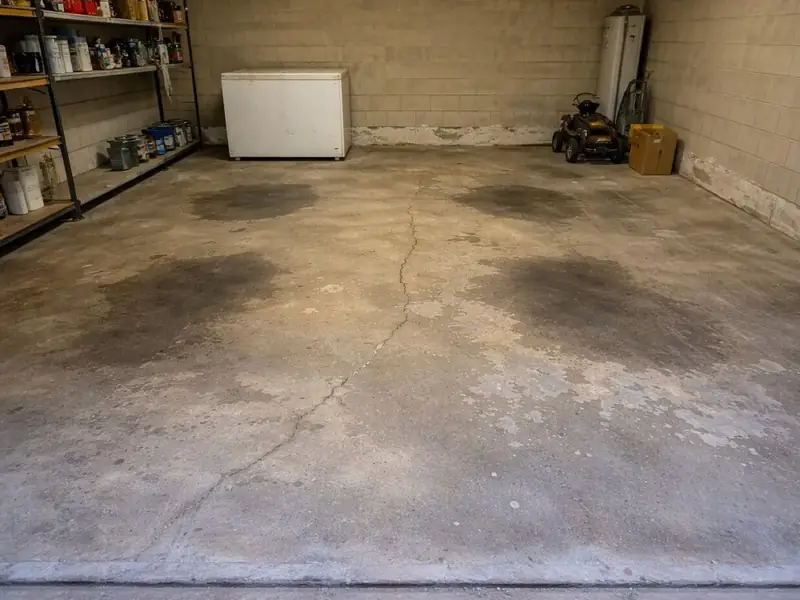
Census Bureau surveys put the median home in the city of Cincinnati at 1952 but in Warren and Boone counties at 1997. Town by town, Newport's median is 1947 and Mason's 1996. An older slab usually needs repair before it is coated; a newer one mostly needs protecting.
Garage Flooring Options, From Paint to Concrete Coatings and Tiles
Roughly cheapest first; the full price set is below. Unsure about coating at all? Read our honest look at whether epoxy is worth it.
Garage floor paint
The cheapest way to change a slab's color. Paint is a thin film resting on the surface; HomeGuide, a national cost guide, puts a professionally painted two-car garage at roughly $800 to $2,300. Fine for storage, but under daily parking it is the first thing to scuff, lift under hot tires and wear through by the door.
DIY epoxy kits
Many boxed kits are water-based or thinned to roll on easily, which also means a thinner coat. The weak link is prep: you scrub or etch the slab, where an installer grinds it. On sound, newer concrete a patient DIYer can do well; on an older, oily or cracked slab, a kit coat has little to hold on to.
Professional solid-color epoxy
An installed floor starts with ground concrete and a thick, two-part coat that locks onto it. In one solid color, mixed from 100%-solids epoxy, it is the plainest pro option at about $3 to $6 per square foot. In a garage it usually serves as the base coat, because ordinary epoxy can yellow in sunlight and dulls sooner as the top layer.
Flake floors
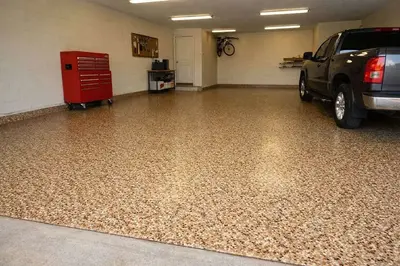
The floor most people picture: colored flakes, or chips, broadcast into the wet base coat and sealed under a clear top coat. They add texture and hide dust and tire marks. We custom-mix base colors, can work in mica or glitter and add a non-slip additive on request. One customer, back for a second floor:
“Second time using Nick’s company. Prompt, reasonable, and a beautiful result. Wounded Warrior is my color of choice.”
Dax Farmer, Google review
Polyaspartic top coats
Part of the polyurea family, polyaspartic is usually the clear layer over an epoxy base and flake. It cures quickly, holds its color in sun and gives tires and gritty slush a harder surface than epoxy alone. It is no weekend project. We offer polyaspartic and polyurea coatings; our epoxy vs. polyaspartic comparison covers the trade-offs.
Metallic epoxy
Pigment is worked through the epoxy by hand so it swirls like poured metal or marble, and no two floors match. Colors include blue, red, silver and bronze. It is the showpiece, typically about $6 to $12 per square foot. More in our metallic flooring guide.
Garage floor coverings: interlocking tiles and mats
Snap-together tiles and roll-out mats cover the slab instead of bonding to it. Nothing has to cure and they move house with you. The catch is underneath: meltwater, salt and grit slip through the joints and stay on the concrete, out of sight. A parking mat under each car is still a sensible winter extra on a coated floor.
The Options Side by Side
For a garage with daily parking; costs are typical, not quotes.
| Option | Salt slush and hot tires | Typical cost |
|---|---|---|
| Garage floor paint | Scuffs and can lift under hot tires | About $800–$2,300 for a painted 2-car garage (HomeGuide) |
| DIY epoxy kit | Only as good as the scrub-or-etch prep | Kit price plus your weekend |
| Solid-color epoxy, installed | Tough base; dulls sooner as the top layer | About $3–$6 per sq ft |
| Flake floor, polyaspartic top coat | Slush stays on top and squeegees off | About $5–$10 per sq ft; 2-car about $2,000–$5,000 |
| Metallic epoxy | Depends on the top coat chosen | About $6–$12 per sq ft |
| Tiles or mats | No tire pickup; water gets under the joints | Varies by product |
Pick a size and a finish, play with colors, and see the typical range for that floor. We turn it into a real number once we have seen your concrete.
Open Floor Studio →Salt, Freezes and Hot Tires
NOAA's 1991–2020 normals for CVG, the Cincinnati/Northern Kentucky International Airport in Boone County, Kentucky, count about 100 nights a year at or below freezing, some 22 days that never get above it and 23.3 inches of snow. Most cold nights thaw by afternoon, so a slab freezes and thaws again and again.
The City of Cincinnati treats hills, bridges and main routes with salt or brine before a storm, and in February 2021 Kentucky's District 6 had 16,500 tons stockpiled for Boone, Kenton and Campbell counties. Some of it rides home on your tires.
On bare concrete, de-icers keep the surface wetter and add to its freezing and thawing, which speeds up scaling. That is why the National Ready Mixed Concrete Association tells homeowners to hose salt off garage slabs. A slab that already flakes gets repaired before anything goes on it.
On a coated floor, the salty water sits on a sealed layer, where a squeegee or hose moves it out the door. Cleanup gets easier and the salt stays at the surface, though no coating rescues weak concrete.
Hot-tire pickup is the summer problem. CVG averages about 22 days a year at 90°F or hotter, and warm tires parked on a thin, soft film such as paint or a light kit coat can grab it and tear it loose. A thick, fully cured system resists it far better. See why coatings let go at the garage door and our Cincinnati climate guide.
Prep Decides the Result
A coating cannot grip dust, oil, old sealer or a slick troweled surface, and grinding is what removes them.
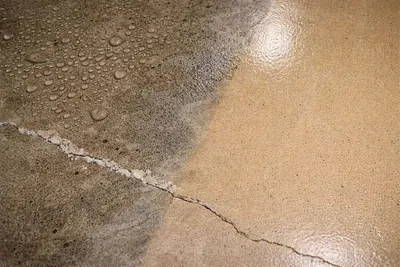
On our jobs the concrete is ground or sanded smooth, and cracks, holes and divots are filled before any coating goes down. Some slabs carry moisture, basements especially, so we check the slab before recommending a system; where it holds too much, a moisture-mitigation primer can go under the coating. More on our basement floor page.
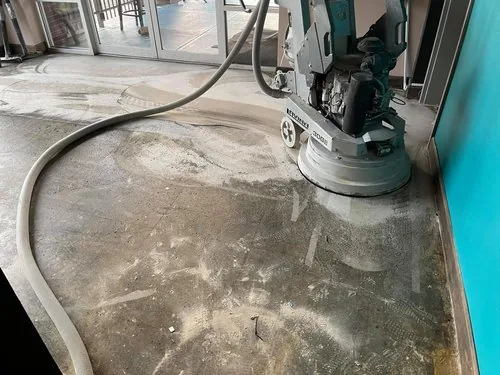
Prep, grinding · from one of our jobs
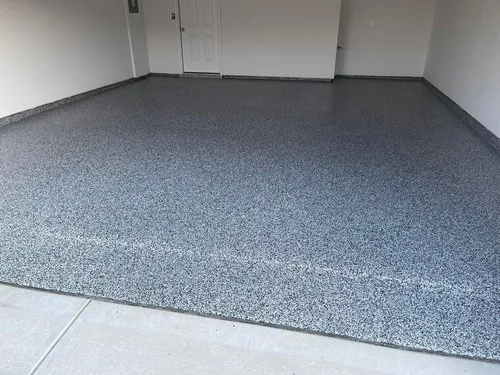
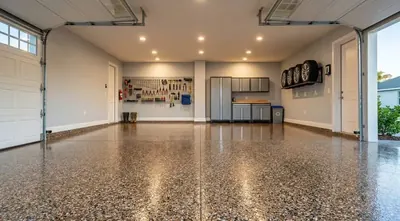
Two-car garage, black-and-white flake · from one of our jobs
Cracks get their own look. Cincinnati's hillsides sit on clay-rich shale, and some local soils swell and shrink between wet and dry spells, so a crack may still be moving. No coating holds a moving crack together; if we find one, we tell you before we coat. More photos from our own jobs are in the gallery.
Typical Prices
Our typical ranges, drawn from published cost guides where they overlap. Not a quote: we price each floor after measuring it and seeing the concrete. Our full cost guide explains what moves a job up or down.
| Floor or add-on | Typical range (not a quote) |
|---|---|
| Flake floor with a polyaspartic top coat | About $5–$10 per sq ft |
| 1-car / 2-car / 3-car garage, flake | About $1,000–$3,000 / $2,000–$5,000 / $3,000–$8,000 |
| Solid-color epoxy | About $3–$6 per sq ft |
| Metallic epoxy | About $6–$12 per sq ft |
| Crack patching | About $25–$250 |
| Resurfacing a badly damaged slab | About $3–$7 per sq ft |
| Moisture testing | About $50–$300 |
| Moisture-mitigation primer, where needed | About $1–$3 more per sq ft |
Comparing quotes? Compare the price per square foot for the same system; a cheaper total often means fewer coats or less prep.
Want a Real Number for Your Garage?
We measure, look over the concrete and talk through the options before we price anything. The visit is free.
How to Read a Garage Floor Quote
A quote you can rely on spells out:
- Square footage measured on site, not guessed.
- The prep: grinding or sanding, and how cracks and divots get filled. A pressure wash alone is not prep.
- Every layer, from base coat to flake or pigment to top coat.
- A moisture plan and its cost if the slab is damp.
- Walk-on and drive-on times for that system.
- The paperwork: who does the work, whether they are licensed and insured, and the terms in writing.
Our peel guide adds five questions to ask before you sign. One metallic-garage customer described the planning:
“…Nick sat down with me and laid out the plan with the colors to achieve the look that we wanted. He then described the process and timeline necessary to complete the work. He sent pics throughout the process to keep me informed…”
John Vu, Google review
Epoxy Flooring Cincinnati is licensed and insured and has been serving Greater Cincinnati since 2019. We quote in person, install with our crew and take before, during and after photos. You get a written warranty before any deposit; ask us for the warranty terms on the system you choose. The business is rated 5.0 on Google from 59 reviews: read them on Google (opens in a new tab).
Looking After a Coated Floor
- Sweep or dust-mop often; fine grit is what dulls a finish.
- After a slushy drive, squeegee the meltwater out the door or hose it off before it dries into a white crust.
- Clean with water or a mild, pH-neutral cleaner; skip harsh solvents and scouring pads.
- Plan a fresh top coat when traffic lanes look dull or worn, or stains stop lifting.
Our maintenance guide has the season-by-season routine.
Which One Fits Your Garage
- Daily parking on salted roads: flake over epoxy with a polyaspartic top coat.
- Storage or a light-use workshop: solid-color epoxy, or paint on a tight budget.
- A bar, gym or show space: metallic or a bold flake blend.
- Renting or moving soon: tiles or mats.
We coat garage floors on both sides of the river: Cincinnati, Mason, Fairfield, Blue Ash, Loveland, Sharonville, Springdale, Lebanon and Hamilton in Ohio, and Florence, Erlanger, Newport and Fort Thomas in Northern Kentucky.
Frequently Asked Questions
What is the best garage floor coating for a Cincinnati winter?
For a garage you park in daily, usually a layered floor: an epoxy base with flake broadcast into it and a clear polyaspartic top coat. The top coat keeps salty slush on the surface, where it squeegees away, and stands up to hot tires.
How much does a garage floor coating cost around Cincinnati?
Typically about $2,000 to $5,000 for a two-car garage with a flake floor and polyaspartic top coat, or about $5 to $10 per square foot. Solid-color epoxy runs about $3 to $6 per square foot and metallic about $6 to $12. We price your floor after seeing the slab.
Do you coat garage floors in Northern Kentucky?
Yes. We work in Florence, Erlanger, Newport and Fort Thomas, as well as nine towns on the Ohio side. Call (513) 434-8103, Monday to Friday, 9 AM to 6 PM, to set up a free quote.
Is a concrete floor coating the same as epoxy?
Not always. Concrete floor coating is a broad label that takes in everything from a coat of floor paint to a full epoxy, flake and polyaspartic system. What separates them is the prep and the number of layers; on our jobs the slab is ground smooth and cracks are filled before any coating goes on.