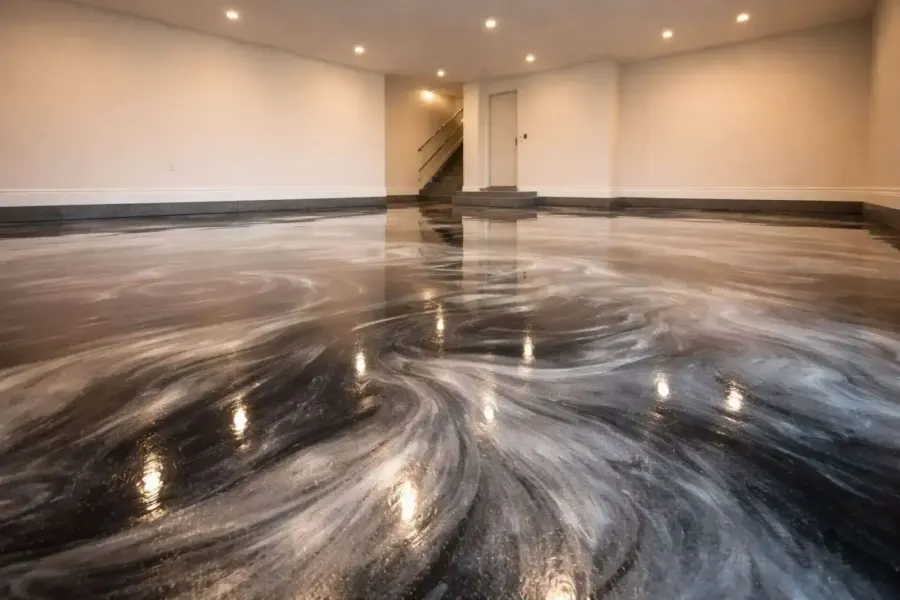
A metallic epoxy floor looks poured rather than painted. Light moves through it, the color shifts as you walk across, and the pattern can read like marble, stone or brushed metal. Among the finishes we install it is the showpiece, and it tends to go where people spend time: finished basements, home bars and garages that double as a showroom.
This guide covers how the look is made, the colors, what one of our reviewers ended up with, and how metallic compares with flake and solid color. Prices are the typical ranges from our cost guide, not quotes.
What Makes a Floor Metallic
How the look is made
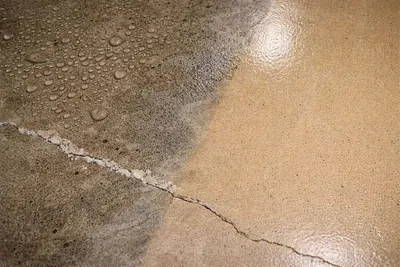
The finish is an epoxy carrying fine metallic pigment. While it is still wet, the pigment is moved around so it gathers into swirls, veins and pools, which is what gives the floor its depth. A clear top coat goes over it once it has set. Underneath, the prep is the same as for any coated floor: the concrete is ground smooth and its cracks, holes and divots are filled first. A glossy metallic surface shows every flaw below it, so that step matters even more here. Metallic is one variation on the layered build every coated floor shares, which our guide to what each layer of an epoxy floor does walks through.
Why no two floors match
Because the pattern forms by hand in a wet coat, it can't be copied exactly from a photo, and two floors mixed from the same colors will still differ. Most owners see that as the appeal. If you need a floor that matches a sample exactly, choose a solid color or a flake blend.
Picturing metallic in your basement, bar or garage?
Call us or send the short form. We come out, measure and price it in person, free.
Colors: Blue, Red, Silver, Bronze and More
Metallic colors on offer include blue, red, silver and bronze, and colors are mixed to order rather than picked from a short menu.
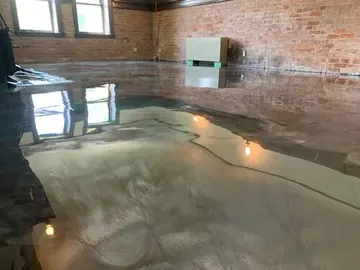
From our own jobs See all 36 photos →
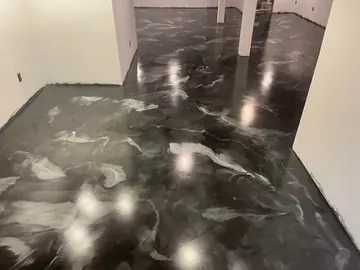
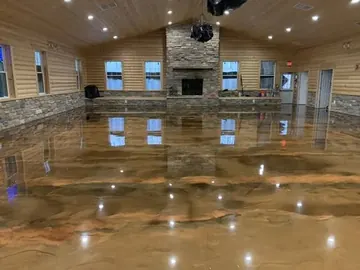
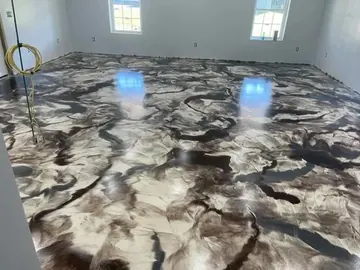
Settling on a palette
Start with what else is in the room: cabinets, walls, a bar top, the car that will sit on it. Silver sits quietly with almost anything. Bronze warms a basement that gets little daylight. Blue and red are statement colors, best kept to one room. You can try combinations in Floor Studio before you talk colors through with us.
Sparkle and grip
Mica or glitter can go into the mix for shimmer, and a non-slip additive can go into the top coat. On a smooth metallic surface that additive is worth considering anywhere water, snowmelt or spilled drinks are likely.
A Metallic Garage, in a Customer's Words
John Vu had a metallic epoxy garage floor done and described the job in his Google review:
“Nick and Bryant did a fantastic job on our garage floor. Nick sat down with me and laid out the plan with the colors to achieve the look that we wanted. He then described the process and timeline necessary to complete the work. He sent pics throughout the process to keep me informed. The metallic epoxy turned out great! Almost looks like a natural matte finished marbled look.”
John Vu, Google review
What to take from it
Three things in that review apply to any metallic floor. The colors are planned before anything is mixed, because they can't be changed once the pattern is worked. The process and timeline are laid out up front, because a metallic floor goes down in several coats with cure time between them. And photos along the way help, because the pattern forms during the work; we provide before, during and after pictures of a job. Note, too, that John describes a matte, marbled look: metallic doesn't have to mean high gloss.
Metallic Next to Flake and Solid Color
Flake
Colored chips are broadcast into the base coat and sealed under a clear top coat. It's the everyday garage floor: the chips hide dust and small blemishes and add texture underfoot, at about $5 to $10 per square foot with a polyaspartic top. Dax Farmer summed up his flake floor in his Google review: “Second time using Nick’s company. Prompt, reasonable, and a beautiful result. Wounded Warrior is my color of choice.”
Solid color
One color mixed to order, with no chips or swirl. It's the plainest and least expensive of the three, at about $3 to $6 per square foot, and suits laundry rooms, storage rooms and workshops where the floor just needs to be bright and easy to sweep.
The Three Finishes at a Glance
Typical installed prices per square foot, not quotes.
| Compared on | Metallic | Flake | Solid color |
|---|---|---|---|
| Look | Swirled, marbled depth | Speckled chips | One even color |
| Typical price | About $6 – $12 | About $5 – $10 (polyaspartic top) | About $3 – $6 |
| Hides dust and scuffs | Least | Most | Some |
| Underfoot | Smooth; non-slip additive available | Textured | Smooth; non-slip additive available |
| Best rooms | Rec rooms, bars, show garages | Everyday garages, mudrooms | Laundry, storage, workshops |
| DIY? | No; hand-worked and hard to redo | Partly; the prep is the hard part | Partly; the prep is the hard part |
Whichever finish you choose, the concrete underneath decides how it lasts. A slab that hasn't been ground and patched, or one that holds moisture, will let any of them down.
Try the three finishes in your own colors for a typical range, then talk it through with us.
Open Floor Studio →Where Metallic Works, and Where It Doesn't
Basements
A finished basement is the classic spot, and basements are a real part of the work here: our Google profile lists “basement floor” as a topic in eight reviews. Census figures show half of the new homes finished in the Midwest in 2025 had a full or partial basement, and in Cincinnati itself 41.6% of housing units date from before 1940. Below-grade concrete can hold moisture, though, and a glossy metallic floor is the wrong place to find that out. We look at the slab's moisture before suggesting a finish; if a mitigation primer is needed, it typically adds about $1 to $3 per square foot. More on basement and residential epoxy flooring.
Garages
Metallic suits a garage that is more showroom than workshop. It is smoother than flake and shows dust and tire marks sooner, so it's for owners who don't mind a quick mop. If winter slush reaches the floor, ask for the non-slip additive. John Vu's floor, above, is a garage, and the other garage finishes are on our garage floor coating page.
Hard-working floors
Where heavy tools drop and carts roll all day, a textured flake floor or a plain solid color is the practical choice; metallic's appeal is its smooth surface, and heavy work scratches it. For business floors, see our commercial guide.
Thinking About a Metallic Floor?
We'll look at the concrete, talk through colors and quote the floor in person, free.
Cost and Sheen
What metallic typically costs
About $6 to $12 per square foot installed, as a typical range; Bob Vila's national cost guide lists metallic epoxy at $5 to $12. Floor size, slab repairs, the number of colors and coats, and any moisture primer move it within that range. For scale, a 2-car garage in flake with a polyaspartic top typically runs about $2,000 to $5,000, and metallic usually costs more per square foot. Your own figure comes after we have seen the slab.
Matte or gloss
Gloss deepens the pattern and throws back more light, but it shows dust, scuffs and footprints sooner. Matte or satin is calmer and more forgiving day to day, and as John's review suggests, metallic can carry a matte look too.
Frequently Asked Questions
How much does a metallic epoxy floor cost in the Cincinnati area?
Typically about $6 to $12 per square foot installed. Treat it as a starting point: floor size, slab repairs, the number of colors and coats, and any moisture primer all move it. We quote each floor in person after seeing it.
Can metallic epoxy go in a basement?
Yes, if the slab is dry enough. Basement concrete sits against the ground and can carry moisture. We check the slab for it before choosing a system; where the concrete holds too much, a mitigation primer typically goes down first. Leaks and standing water have to be dealt with before any floor is coated.
What colors can a metallic floor be?
Blue, red, silver and bronze are among the colors offered, and colors are mixed to order. Mica or glitter can be added for shimmer. Try combinations in Floor Studio, then settle the plan with us.
Is metallic epoxy slippery?
It can be when wet, because the surface is smooth. A non-slip additive can be mixed into the top coat, which is worth doing in garages, basements and bars. Flake floors have more texture on their own.
Is metallic as tough as a flake floor?
Under a good top coat it holds up to normal home use, but it shows scratches, dust and wear sooner than flake, whose chips hide small marks. For a hard-working garage, flake is the practical choice; for a rec room or show garage, metallic earns its place.