Price a coated floor anywhere in Greater Cincinnati and three words keep coming up: epoxy, polyaspartic and polyurea. It's tempting to look for a single winner, and some ads sell one of them as many times stronger than epoxy, but in practice they do different jobs, and many good floors use two of them in layers. The room should decide: a garage that takes salty slush all winter, a basement that stays cool and can get damp, or a shop that needs its floor back fast.
Here are the three in plain terms, matched to the two rooms our Google reviews mention most, garages and basements. Prices are typical ranges, not quotes.
Epoxy, the Base Coat Most Floors Start With
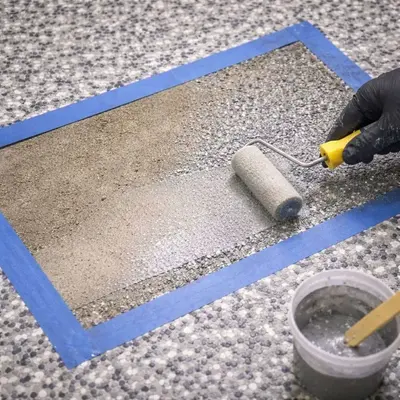
Epoxy is a resin and a hardener, mixed on site, that sets into a tough film locked onto the concrete. It goes on thick, so it builds a solid first layer over a slab that has been ground smooth and patched.
What epoxy does well
- Build and bond. One coat lays down more film than polyaspartic and grips freshly ground concrete hard, which is why so many systems start with it.
- Color. It carries pigment well. Solid colors and swirled metallic looks are both epoxy finishes.
- Price. Solid-color epoxy is the cheapest line in our price block, at about $3 to $6 per square foot.
Where epoxy falls short
- Sunlight. Ordinary epoxy isn't UV-stable. Where sun reaches it, it can amber over time.
- Cure time. It cures more slowly than polyaspartic, and slower still on cold concrete.
- Top-layer wear. As the exposed surface of a garage floor, it scuffs and dulls sooner than a harder top coat.
Not sure which coating fits your room?
We talk through epoxy, polyaspartic and polyurea on site, then price the system that suits your floor. The visit is free.
Polyaspartic and Polyurea, in Plain Terms
Polyurea is a family of very fast-setting industrial coatings. Polyaspartic is a member that reacts a little more slowly, giving an installer time to roll it out evenly; at home it usually shows up as the clear top coat over a colored base and flake. We offer both, as well as epoxy.
What polyaspartic does well
- Speed. It cures far faster than epoxy, so the floor comes back into use sooner.
- Cooler slabs. It keeps curing at temperatures that stall standard epoxy. Each product lists its own minimum.
- Color hold. Polyaspartic top coats are made to stay clear in UV light.
- A harder wear layer. It takes tires and grit better than bare epoxy, and salty slush sits on it instead of soaking into the concrete.
Where it asks more of the installer
- Short pot life. Once mixed it thickens fast, so it's a poor DIY product.
- Thin, pricier coats. Each pass is thinner than epoxy and costs more per gallon.
The Three Side by Side
A quick reference; prices are our typical, not-a-quote ranges.
| Question | Epoxy | Polyaspartic / polyurea |
|---|---|---|
| Cure speed | Slower, and slower again on a cold slab | Fast |
| Cold concrete | Wants a warmer slab | Cures at lower temperatures (check the product's minimum) |
| Sunlight | Can amber if left as the top layer | Holds its color |
| Salt slush and tires | Fine under a top coat; wears sooner on top | Hard surface that rinses clean |
| Typical price | Solid color about $3–$6/sq ft; metallic about $6–$12/sq ft | Flake floor with polyaspartic top about $5–$10/sq ft |
| Usual role | Base coat; solid and metallic finishes | Clear top coat, especially in garages |
Choose your garage size, finish and colors. You get a typical range, not a bid; we firm it up after seeing the slab.
Open Floor Studio →Cold Slabs, Humid Summers and Road Salt
Winter here is real. NOAA's 1991–2020 normals for the official station at CVG, in Boone County, Kentucky, show about 100 nights a year at or below freezing, some 22 days that never get above it, and 23.3 inches of snow. Most freezing nights thaw by afternoon.
Standard epoxy cures slowly on a cold garage slab, so a faster polyaspartic coat is often chosen in colder months. In humid summer weather, moisture can condense on a cool slab, which no coating likes. Either way, a pro should judge the slab before mixing.
Road salt makes the top coat matter
The City of Cincinnati treats hills, bridges and main roads with salt or brine before storms, and KYTC's District 6 had 16,500 tons of salt stockpiled for Boone, Kenton and Campbell counties in February 2021. That slush rides home on your tires.
The National Ready Mixed Concrete Association tells homeowners to hose salt off garage slabs, because de-icers soak the surface and worsen freeze-thaw damage; Ohio's code even groups garage slabs with outdoor porches and steps. A hard top coat keeps the slush on the surface, where it squeegees or rinses away. Concrete that is already flaking is ground back and repaired first. More in why coatings peel at the garage door and our climate guide.
Layered Floors and Typical Prices
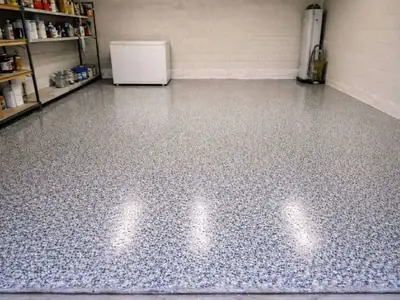
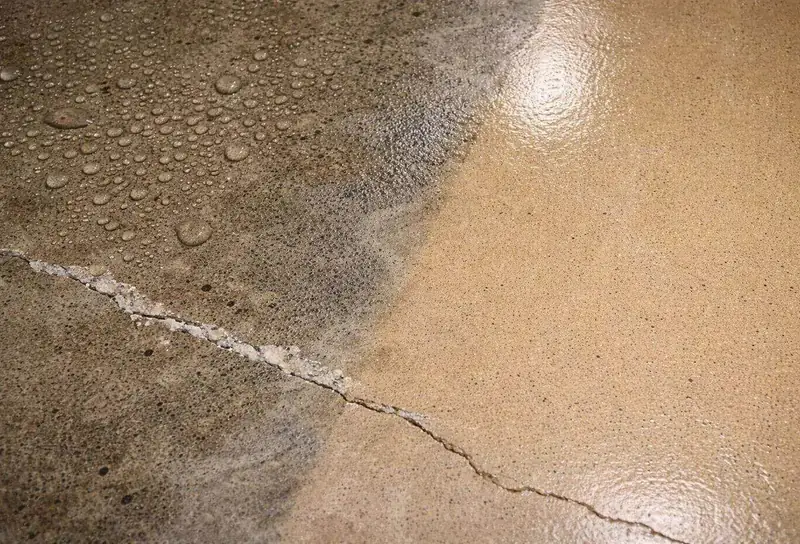
So epoxy works best underneath and polyaspartic on top. The layered garage floor goes down in stages: the slab is ground and patched, a custom-mixed base coat goes on with colored flake broadcast into it, and a clear polyaspartic top coat seals it. We explain what each layer of an epoxy garage floor does separately, and our buyer's guide to garage flooring in Cincinnati sets this floor beside paint, kits and tiles. Ask us to price it next to an epoxy-only floor.
What it typically costs
- Flake floor with a polyaspartic top coat: about $5 to $10 per square foot, or about $1,000 to $3,000 for a 1-car garage, $2,000 to $5,000 for a 2-car and $3,000 to $8,000 for a 3-car.
- Solid-color epoxy: about $3 to $6 per square foot. Metallic epoxy: about $6 to $12.
- Slab work, if needed: crack patching about $25 to $250, resurfacing a badly damaged slab about $3 to $7 per square foot, moisture testing about $50 to $300, and a mitigation primer about $1 to $3 more per square foot.
For comparison, HomeGuide's national guide puts epoxy at $4 to $10 per square foot, polyurea at $5 to $10 and polyaspartic at $5 to $12. Our cost guide goes deeper.
Want Both Options Priced for Your Floor?
We come out, measure, look at the concrete and quote in person. The quote is free.
Garage, Basement or Shop: Which Coating Goes Where
A garage you park in every day
Here the layered floor earns its keep: salt, meltwater, hot tires and sun all land on the top layer. House age matters too. Cincinnati's median home was built in 1952, and slabs that old often need more grinding and patching. Mason's median home dates from 1996, so there the job is usually protection, not rescue.
A basement floor
Below-grade basement floors are the other big job. Away from sun and salt, epoxy can do most of the work: solid color for a laundry room, metallic for a rec room. The catch is water in the concrete. We check the slab before we recommend a system; if the concrete holds too much moisture, a mitigation primer usually goes under the coating. No coating makes a wet basement dry, but a coated floor is far easier to clean if water gets in. Krystal & Til had a basement laundry room done:
“Nick was prompt and very responsive. Our epoxy floor in our basement laundry room was done in a reasonable amount of time and it’s beautiful! They even ground down imperfections and sealed cracks. We definitely recommend!!”
Krystal & Til, Google review
A business that can't close for long
For a commercial floor, fast cure usually decides it, because every closed day costs money. Our commercial guide covers downtime, and our metallic guide covers show floors.
Frequently Asked Questions
Is polyaspartic better than epoxy for a garage in Cincinnati?
As the top coat, usually yes: it cures faster, holds its color in sunlight and gives salt slush and hot tires a harder surface. Epoxy still earns its place underneath as a thick, well-bonded base. A salted garage is usually best served by both.
Can a floor coating go down in the winter?
Often, with the right product. Standard epoxy struggles on cold concrete, while polyaspartic and polyurea products work at cooler slab temperatures, each to its own listed minimum. We check the slab and tell you which system suits the season.
Where does polyurea fit in?
It is the wider family polyaspartic belongs to. Classic polyurea sets extremely fast and suits spray equipment; polyaspartic is slowed down enough to roll out on a floor. HomeGuide prices polyurea at $5 to $10 per square foot and polyaspartic at $5 to $12. We offer both.
How soon can I walk and park on the new floor?
It depends on the system, the number of coats and how warm the slab is. A fast-curing top coat shortens the wait. Ask us for the walk-on and drive-on times for the system you choose.
What does a coated 2-car garage cost around here?
Typically about $2,000 to $5,000 for a flake floor with a polyaspartic top coat, or roughly $5 to $10 per square foot. Cracks, wear or a damp slab push it up, and the real number comes once we have walked the garage.