Usually yes for a garage you park in all winter or a basement you want to use, as long as the slab is sound and the prep is done properly. Often no if the concrete is still moving, the basement is actively wet, or the plan is a cheap coat over dirty concrete. Here is where that line falls for homes in Greater Cincinnati and Northern Kentucky.
Prices first? The Cincinnati epoxy cost guide breaks them down by coating and garage size.
What “Worth It” Means Here
A coating earns its keep when what you get back (easier cleanup, a room you actually use, a floor you like looking at) outweighs the check. For most two-car garages that check comes to roughly $2,000 to $5,000, typical for a flake floor under a polyaspartic top coat, not a quote.
How many years it buys is the part nobody can honestly promise; that depends on the system, the prep and what the floor has to put up with. A basement laundry room and a garage that takes a salty SUV every night from December through March are different jobs. Ask us what to expect from the system we recommend for your floor.
Want your own number, not a range?
We measure the floor and look at the slab before we price anything. The visit is free.
What You Get for the Money
Salt slush that sits on top instead of soaking in
Winters at the CVG airport weather station are real but not extreme: about 100 nights a year at or below freezing and roughly 23 inches of snow, going by NOAA's 1991–2020 normals, with most freezing nights thawing out by afternoon. Crews on both sides of the river answer with salt and brine, and the slush rides home on your tires. The concrete industry's own advice (NRMCA) is to hose salt off garage slabs, because de-icers make surface scaling worse. On a coated floor the slush stays on the surface, where a squeegee or a hose sends it out the door.
Cleanup in minutes
Oil drips, grass clippings and laundry spills wipe off a sealed surface instead of staining raw concrete. In a basement, a coated floor can be mopped and disinfected after water gets in. It won't keep the water out, but the cleanup is far less grim.
An old, tired slab that looks new again
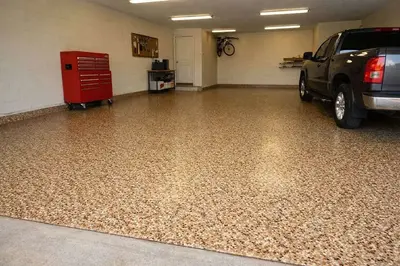
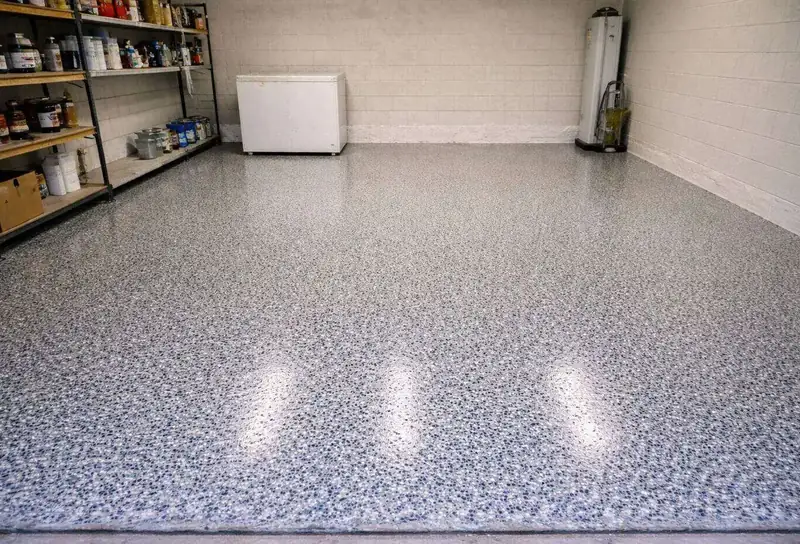
In the older parts of the region, garage and basement concrete has often been around for generations; half of Cincinnati's homes were already standing by 1952. Across the river, Newport's midpoint is 1947. Grinding that surface smooth, filling cracks, holes and divots, then broadcasting a flake blend over a custom-mixed base gives a uniform floor without pouring new concrete.
A finish you actually pick
Flake, mica and glitter blends, solid colors, or metallic epoxy in shades like blue, red, silver and bronze. John Vu summed up the metallic garage floor our crew did for him:
“…The metallic epoxy turned out great! Almost looks like a natural matte finished marbled look.”
— John Vu, Google review
The Downsides
The up-front cost is real
Spending thousands on a surface you mostly walk across is a real decision. If money is tight and the concrete is sound, waiting a year is a reasonable call.
Everything rides on the prep
A coating is only as good as its grip. Skip the grinding, leave the cracks or coat over grease or damp, and it is on borrowed time whatever the product. We grind the slab smooth and fill cracks, holes and divots before the first coat.
Some slabs need fixing or drying first
Basement slabs can hold moisture, so we look at the slab before we suggest a system. Sometimes that means adding a moisture-mitigation primer (usually about $1 to $3 more per square foot); now and then it means “not yet”. Hillside ground is the other catch. Plenty of local slopes are blanketed in clay weathered from shale, which can slip when disturbed, and certain soils here swell in wet weather and shrink in dry. No coating can hold together a crack that is still opening. If we see movement, we say so before anything goes down.
Downtime, and a slick surface when wet
The space is out of use while the coats go on and cure; ask us for the walk-on and drive-on times of the system you choose. A smooth coated floor can also get slick when snowmelt drips off the car, so ask about the non-slip additive for a garage or a laundry room.
Don't count on a resale bump
HomeAdvisor's cost guide says plainly that epoxy floors don't raise a home's formal appraisal value. A clean floor may help a house show well, but buy one because you will use it, not as an investment.
Coating vs. Paint, Tiles or Bare Concrete
The usual alternatives, in plain words:
| Option | Up-front cost | Winter slush | The catch |
|---|---|---|---|
| Leave it bare | None | Soaks into the surface unless you hose it off | Stains and flaking stay your problem |
| Garage floor paint | About $800–$2,300 for a painted 2-car garage (HomeGuide) | Sits on a thin film | Thin film that can lift under hot tires |
| Interlocking tiles | Depends on the tile you choose | Grit and water work into the seams | Tiles come up to clean underneath |
| Installed epoxy, polyaspartic or polyurea | Typically about $2,000–$5,000 for a 2-car flake floor | Sits on top; squeegee or hose it out | Needs proper prep and time to cure |
The other routes leave more of the winter mess in the concrete or in your weekend. More on the weather side: how Cincinnati's climate affects floor durability. To weigh every garage floor covering in more depth, from paint and kits to tiles, read our garage floor coating buyer's guide; for why a real system outlasts a painted film, see epoxy vs. garage floor paint, layer by layer.
Try finishes and colors on a garage like yours and see the typical price range in Floor Studio.
Open Floor Studio →When It Pays Off
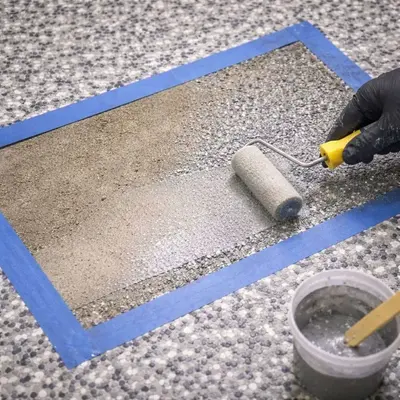
- A garage you park in every day through salt season. That is where slush and hot tires hit bare concrete hardest. How a garage floor gets coated.
- A basement or bar you want to use. A laundry room, a rec room, a bar (basement and home floors). Sarah T’s review of a bar floor: “…I would give them 10 Stars if I could. Highly recommend 👍”
- An old slab you would otherwise put up with. Tired 1950s concrete can become a floor you are happy to show off.
- A newer suburban garage. In Mason, where half the homes went up in 1996 or later, the job is usually protecting a slab that is still in decent shape, not rescuing one.
- You plan to stay. The longer you use the floor, the better the up-front cost looks.
Not Sure Which Side Your Floor Is On?
We'll look at the slab, tell you what we see and give you a free quote.
When to Wait or Skip It
- The slab is still moving. Fresh or widening cracks on a hillside lot need a structural answer first.
- The basement is actively wet. Deal with the water, then talk floors. Coating over water that is still coming in is off the table.
- You are selling soon on a tight budget. With no appraisal lift, a deep clean may be the smarter spend.
- You want the cheapest possible weekend refresh. Anything rolled over unground, dirty concrete is likely to lift, and then you pay twice.
- The space is temporary. Concrete that is due to be torn out, or a room you barely use, is the wrong place for a premium system.
Our Bottom Line
For a garage used every day, or a basement you want to enjoy, on a sound, dry slab, a professionally installed coating is usually money well spent. What doesn't pay off is the shortcut: a thin coat on unprepared concrete. Spencer Andriot’s review of a basement floor put it bluntly:
“…TRUST ME YOU GET WHAT YOU PAY FOR, and Epoxy Flooring Cincinnati was no doubt the route to go!!! I HIGHLY RECOMMEND!!!”
— Spencer Andriot, Google review
Not sure where your floor falls? Call (513) 434-8103 or request a free quote online. We'll come out, look at the concrete and give you a candid read on whether a coating makes sense, including when it doesn't.
Frequently Asked Questions
Is epoxy flooring worth the money in Cincinnati?
For a garage you park in every day or a basement you want to use, usually yes, provided the slab is sound and properly prepared. It is not worth it over a moving crack, a basement that is still taking on water, or concrete nobody has prepped.
Does an epoxy floor increase my home's value?
Not on paper. HomeAdvisor's cost guide says epoxy floors don't raise a home's formal appraisal value. A finished floor can help a house show well, but treat that as a bonus, not a return.
Is epoxy a good idea in a basement that has taken on water?
It can be, once the water problem has been dealt with. A coating does not keep water out and should never go over an actively wet slab, and we look for moisture in the slab before anything else. After that, a coated floor is much simpler to clean up if water gets in again.
Will road salt ruin a coated garage floor?
Not if you rinse it off. The salty slush sits on top of the coating instead of soaking into bare concrete, so a squeegee or a hose moves it out the door. Rinsing through the winter is still a good habit.