Most people picture an epoxy garage floor as a shiny coat of paint. A properly installed one is a stack of layers, each with its own job, bonded to concrete that was ground clean first. Know what each layer does and it gets easier to compare quotes, spot a shortcut and see why one floor lasts while another lifts at the door.
Still choosing between paint, kits, flake and tiles? Start with our ultimate guide to garage floor coating in Cincinnati. Prices are in the cost guide.
What an Epoxy Garage Floor Actually Is
Epoxy arrives as two liquids, a resin and a hardener. Mixed, they react and cure into a hard plastic film that grips the concrete it was spread on. That is the real difference from paint: paint dries, epoxy cures.
A garage system has four parts, bottom to top:
- The slab, ground smooth, with cracks, holes and divots filled.
- A primer or base coat that soaks into the opened concrete.
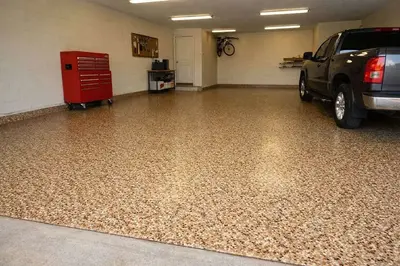
- A decorative layer: flake, metallic pigment or solid color.
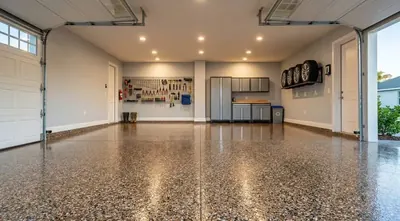
- A clear top coat that takes tires, grit and winter slush.
Each layer leans on the one below. A premium top coat over a poorly prepared slab still fails; it just fails at a higher price.
Layer Zero: The Slab Underneath
Garage concrete is built for a rougher life. The Residential Code of Ohio holds the parking area of a garage to the spec it uses for porches and steps out in the weather, 3,500 psi with entrained air where weathering is severe, against 2,500 psi for a basement slab.
House age matters too. The median build year is 1952 in the city of Cincinnati but 1997 in Warren and Boone counties, so an older-core slab often needs rescuing where a suburban one needs protecting.
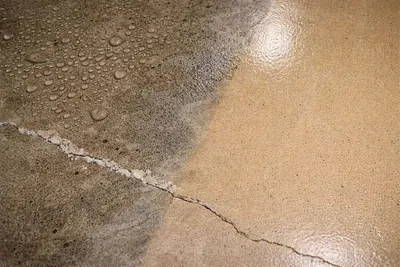
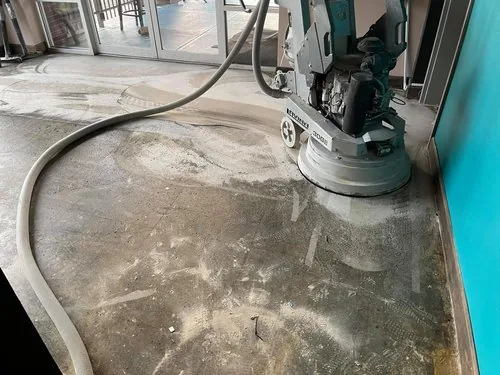
Our crew grinds or sands the concrete smooth, taking off the weak, dusty top layer and old sealers, then fills cracks, holes and divots. On hillside lots, where much of the ground is clay-rich soil weathered from Kope Formation shale, a crack can keep moving. A moving crack opens again through any coating, so we check for movement and tell you before anything goes down.
Layer One: The Primer or Base Coat
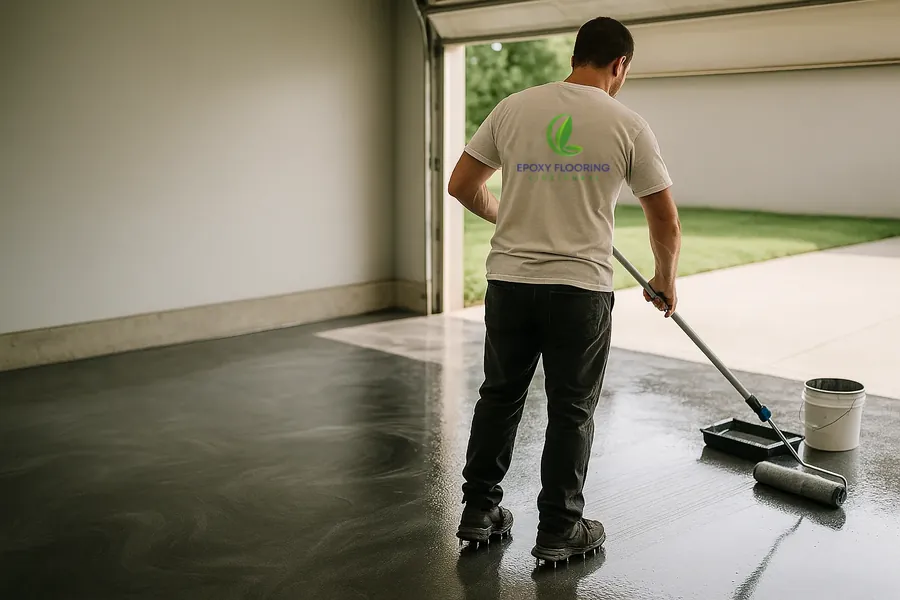
This is where the bond is made. Ground concrete is porous, and a primer, or on some systems the base coat itself, wicks into those pores before it cures, locking the film into the slab rather than leaving it on top. On our floors the base color is custom-mixed for the job.
Its enemy comes from below: basement slabs especially can hold moisture that slowly breaks a coating's grip. We check the slab first; where readings call for it, a moisture-mitigation primer goes down, typically about $1 to $3 more per square foot. It helps a coating hold on damp concrete but does not fix a leaking basement.
Wondering what your slab needs?
We check the concrete and quote in person, free.
Layer Two: Flake, Metallic or Solid Color
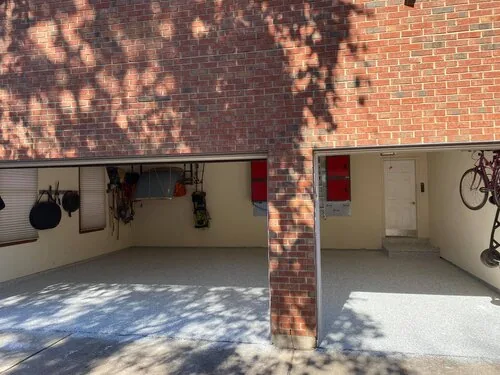
- Flake. Colored chips are broadcast by hand into the wet base and lock in as it cures. Blends, chip sizes, mica and glitter change the look.
- Metallic. Pigment is worked through the wet epoxy by hand, so every floor swirls differently, in colors such as blue, red, silver and bronze (metallic guide).
- Solid color. One color from 100%-solids epoxy, clean and even.
A non-slip additive is available with any of them. Named blends and pigments are in our color catalog. This is the layer people notice; after his garage floor remodel, one customer wrote:
“…Floors are a huge upgrade and look amazing. Highly recommend!”
Andrew Laurence, Google review
Pick flake, metallic or solid color and see a typical range. It isn't a bid; we confirm it on site.
Open Floor Studio →Layer Three: The Clear Top Coat
The top coat is the wear layer. It seals the flake or pigment in, sets the sheen and takes the scuffs and tire traffic. When a good floor looks tired, it is usually this coat that has worn, and it can often be renewed on its own.
Epoxy can be its own top coat, but in a garage it cures slowly and can yellow where sun comes through the door. Polyaspartic and polyurea answer both, and we offer each; polyaspartic over an epoxy base is a common garage build.
It is also the layer that meets winter. Road brine is salt in water (ODOT's mix is about 23% salt by weight), and it drains off your wheel wells toward the door. The concrete industry's NRMCA advises hosing salt off garage slabs, since de-icers worsen scaling. On a sealed top coat the slush just sits until a squeegee or hose sends it out (our maintenance guide has the routine).
Epoxy vs. Garage Floor Paint: Cure vs. Dry
Some one-part floor paints even print “epoxy” on the can. What matters is how the product hardens and what stays on the floor.
| Question | Garage floor paint | Water-based epoxy kit | 100%-solids epoxy system |
|---|---|---|---|
| How it hardens | Dries as water or solvent evaporates | Reacts while its water evaporates | Reacts; almost nothing evaporates |
| Film left behind | Thin | Less than you rolled on | Close to what was spread |
| Usual prep | A clean, sometimes an etch | A wash or acid etch | Ground smooth, repairs filled |
| Built as | Coats of one paint | Usually one coat | Base, flake or pigment, top coat |
| Typical 2-car cost | About $800–$2,300 painted (HomeGuide) | The kit plus your weekend | About $2,000–$5,000 as flake with a polyaspartic top (typical, not a quote) |
Paint suits a floor that only sees feet. A garage gets hot tires, brine, dropped tools and oil, and a thin film on lightly cleaned concrete lets go first. Store kits sit in between: real two-part epoxy, usually one thin coat over light prep. Our low-VOC guide explains what “100%-solids” means.
What It Resists, and What It Doesn't
A sound system handles daily garage life: oil, washer fluid and slush stay on top and wipe or rinse off. In a basement it can be mopped and disinfected if water gets in, though it keeps no water out. Failures come from four places:
- Moisture from below that nobody checked.
- Thin prep. A coat over dusty or oily concrete peels, usually at the door (why it starts there).
- Hot tires on a thin or under-cured film. Ask us for the walk-on and drive-on times for the system you choose.
- A crack still moving underneath.
What to Ask Before You Hire
Ask about each layer:
- How will the slab be prepared? Listen for grinding or sanding and crack repair, not just a wash.
- What goes down at each layer, and why? A good answer names the base, the flake or pigment and the top coat.
- Is the base 100%-solids or water-based? That tells you how much film stays down.
- How heavy is the flake? Ask to see a sample.
- What if the slab is damp or a crack moves? Get the plan and its price up front.
- What is in writing? You get a written warranty before any deposit; ask us for the warranty terms on the system you choose.
Epoxy Flooring Cincinnati is licensed and insured and has been serving Greater Cincinnati since 2019. We quote each floor in person and send before, during and after photos. See how we install a floor or our epoxy garage floor coating service.
Quick Answers
What is an epoxy garage floor?
A coating system, not a coat of paint: two-part epoxy that cures into a hard film on ground, repaired concrete, usually with flake or pigment in the middle and a clear top coat last.
Is epoxy better than garage floor paint?
For a garage you drive into, usually yes. Paint dries into a thin film that can lift under hot tires, while an epoxy system bonds to ground concrete under a top coat built for wear. Paint costs less up front.