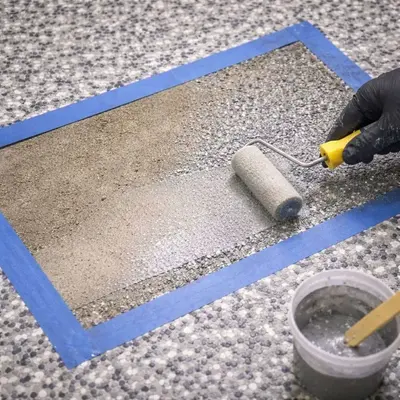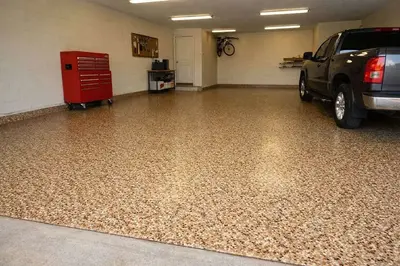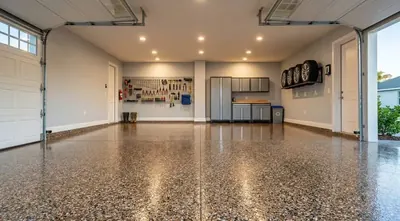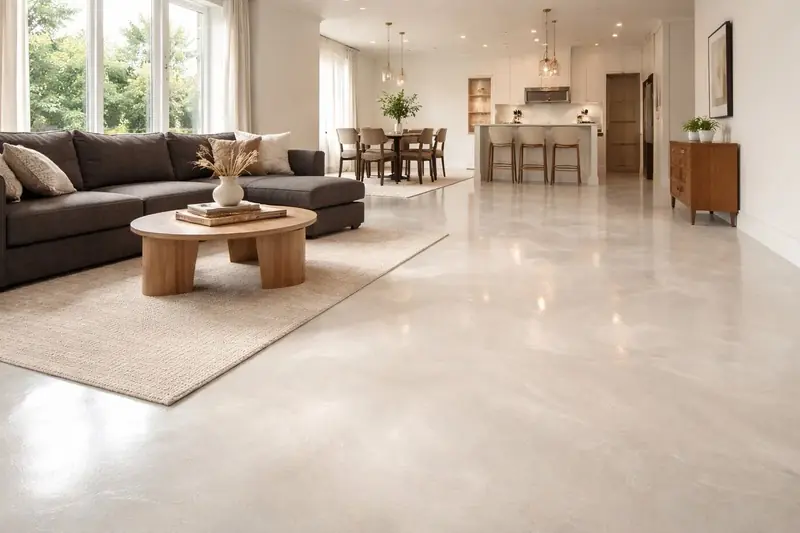
The greenest concrete floor is usually the one you already have. Coating an existing garage or basement slab takes a small fraction of the material a tear-out and repour would, and today's low-VOC and 100%-solids products give off far less solvent than the coatings many people remember.
Across Greater Cincinnati the choice comes up on two kinds of floor: concrete in the older core, much of it from before 1960, and garage slabs in the Warren and Boone county suburbs, many closer to 30 years old. Either way, the real comparison is a coating versus a new pour, tile, vinyl plank, basement carpet, or paint that needs redoing every few years.
For in-home projects, see residential epoxy flooring; for shops and businesses, commercial epoxy flooring. Or call (513) 434-8103.
Coating the Slab You Already Have
Judge any floor on what goes into it, how long it lasts and where it ends up.
Versus a new slab
Breaking out a slab means hauling away broken concrete and making new cement, an energy-hungry material, to replace it. A coating keeps the original slab working, and even with crack repair, primer and a clear top coat it uses a small fraction of the material.
Versus ceramic tile
Tile, thinset and grout are three manufactured products bonded to the slab, and when tile cracks or dates, it all comes up in pieces for the landfill. A coating is a thin film over concrete that's left as it was.
Versus vinyl plank
Vinyl is a plastic, and old plank usually ends up in the trash. A coated floor takes a fresh top coat in place when it wears, and the layers beneath stay put.
Versus carpet in the basement
Carpet over a below-grade slab holds on to whatever a wet day brings, and it gets replaced often. A coated floor can simply be mopped dry and cleaned.
Thinking of keeping the slab you have?
We look it over, measure and quote a coating in person. The visit costs nothing.
What Low-VOC and 100%-Solids Actually Mean
VOCs, or volatile organic compounds, are the solvents that evaporate out of many paints and coatings as they dry, and they're a big part of that sharp fresh-paint smell. For how 100%-solids epoxy, water-based kits and paint compare on strength rather than smell, see our guide to the epoxy garage floor.
- 100%-solids epoxy is resin and hardener with essentially no solvent carrier. Nearly all of it reacts and stays on the floor as the cured film, so there is little to evaporate. Single-color floors here use 100%-solids epoxy.
- Water-based epoxy uses water as the carrier instead of solvent. It's another low-odor choice for finished basements and home gyms, usually as a thinner film.
- Solvent-thinned coatings, including some kits, release the most as they cure. Read the label before you buy.
- Polyaspartic top coats come in low-VOC versions and cure faster than epoxy, which shortens the time a room smells of product. Polyaspartic and polyurea coatings are both available here.
Two cautions. Low-VOC doesn't mean odor-free during the work, so ventilate and keep kids and pets out until the installer says it's ready; ask us for the walk-on and drive-on times for the system you choose. And an eco-sounding label proves little: the product and safety data sheets list the actual VOC content, usually in grams per liter.
Why Service Life Matters
A big part of any floor's environmental cost is how often it has to be replaced.
How long a coated floor lasts depends on the system, the prep, the traffic and the winter care, so we don't hang a year count on it. The wear is meant to land on the clear top coat, and renewing that coat before the color layer wears through keeps the rest of the floor in service. And the part you can't see later matters most: we grind the concrete smooth and fill cracks, holes and divots before any coating goes down, because a coating is only as good as its bond.
Winter care is the other half. Brine and chloride de-icers from local roads ride in on tires along with grit, and rinsing both off the door zone helps the top coat last. Our maintenance guide has the routine.
Ask Us About Low-VOC Options
We measure, look over the slab and quote in person, free. Call Monday to Friday, 9 to 6.
Older Cincinnati Slabs Worth Saving
For the city of Cincinnati, the American Community Survey puts the median year built at 1952, with 41.6% of housing units dating from before 1940; Hamilton County as a whole comes in at 1963. The five-year estimates tell a similar story in older towns nearby: a median of 1947 in Newport, 1955 in Fort Thomas and 1956 in the city of Hamilton.
Stains, pitting and hairline cracks don't mean old concrete has to go. A slab that's sound underneath can be ground smooth, patched and coated, and it stays out of the landfill. Typical, not a quote: crack patching runs about $25–$250, and resurfacing a badly damaged slab about $3–$7 per square foot, based on national cost guides. We quote each floor after seeing it.
Some slabs haven't just aged; they've moved. Many valleys and hillsides around Cincinnati are cut into the Kope Formation, a shale-dominated bedrock that weathers into clay-rich soil, and Ohio DNR's Geological Survey says the Cincinnati area has one of the highest per-capita costs from landslide damage of any US city. Some local soils also swell and shrink between wet and dry spells, and fill made from them can crack basement floors. So we check cracks for movement and tell you what we find before we coat. A coating won't stop a moving slab, and it shouldn't be used to hide one.
Basement slabs can carry moisture too, and we look at that before we suggest a system. Where readings call for it, a moisture-mitigation primer typically adds about $1–$3 per square foot.
Old Floor Tile and Black Adhesive
Some older basements still have 9-by-9 or 12-by-12 vinyl tile, or the black adhesive left where tile was pulled up. Some older floor tiles and adhesives contain asbestos, which becomes a hazard when it's sanded, ground or broken up. If you don't know what's on your basement floor, have a sample tested by a qualified lab before anyone grinds it; if it comes back positive, an asbestos abatement professional deals with it first. Mention any old tile when we come out to measure.
Keeping Waste Down on the Job
How a floor goes in matters too. Worth asking about on any job:
- Measured quantities. We measure the space before we quote. On any job, ask how the material order is sized: resin mixed beyond what the floor needs ends up hardening in a bucket.
- Dust control. Grinding concrete makes fine dust. Ask how it will be contained, and close off the rest of the house while it happens.
- Leftovers and containers. Unused liquid resin and hardener should never go down a drain or into household trash; follow the product's disposal instructions.
- Clean-up. Our crew cleans up when the work is done. From Sarah T's Google review: "They did an amazing job. They were very thorough, took their time, and cleaned up after themselves very nicely. …"
- Honest scope. When a floor is only worn at the surface, the lowest-impact answer may be a fresh top coat rather than a whole new system.
Frequently Asked Questions
Is epoxy flooring environmentally friendly?
It can be, mostly because it keeps an existing slab in use. A coating takes far less material than a tear-out and repour, and low-VOC and 100%-solids products release much less solvent than older coatings.
What do low-VOC and 100%-solids mean?
They describe how much solvent a coating gives off as it cures. A 100%-solids epoxy has essentially no solvent carrier, so almost all of it stays on the floor as the cured film.
Can an old Cincinnati slab be coated instead of replaced?
Usually, if it is sound underneath. Stains, pitting and hairline cracks are handled in prep, and we flag any crack that is still moving before a coating goes down.
Could old basement floor tile contain asbestos?
It might, so have it tested before anyone grinds it. If a lab confirms asbestos, an abatement professional handles it before any coating work.
How long does a low-VOC epoxy floor last?
There is no honest single number; it depends on the system, the prep, the traffic and the care. A weak bond to the concrete, and salt or grit left on the top coat, are common reasons a floor wears out early.
Planning a Lower-Impact Floor?
We work in 13 towns on both sides of the river: Cincinnati, Mason, Fairfield, Blue Ash, Loveland, Sharonville, Springdale, Lebanon and Hamilton in Ohio, plus Florence, Erlanger, Newport and Fort Thomas in Kentucky. We'll measure, look over the slab and talk through systems, low-VOC ones included, before we quote. If there's old tile down, mention it when you call.
Call (513) 434-8103 or request a free quote. For the weather side, see how Cincinnati's climate affects epoxy floor durability; for the spot that fails first, read why Cincinnati epoxy floors peel at the garage door.