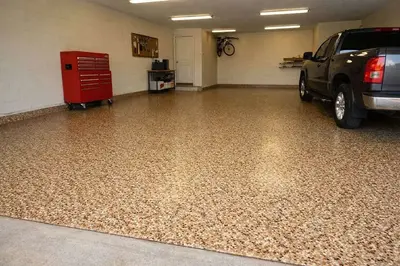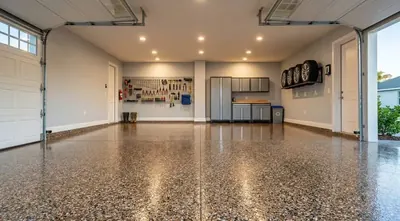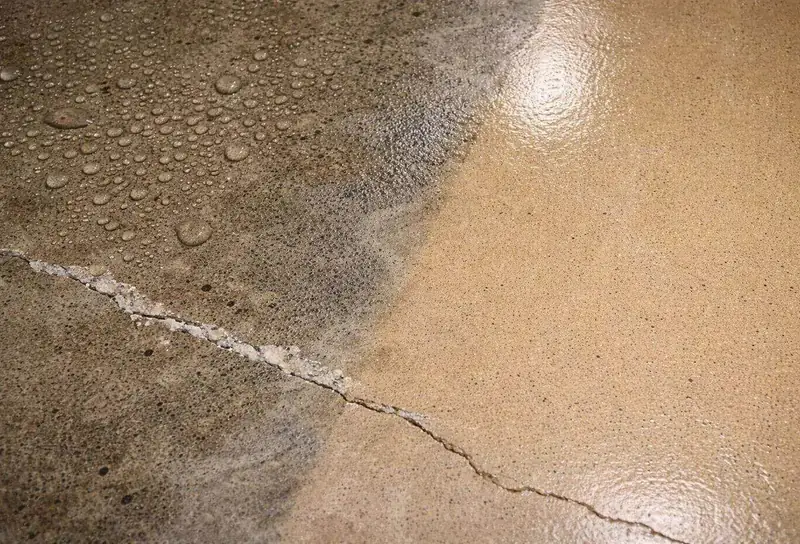
The weather numbers here come from the official Cincinnati station at CVG airport, which actually sits in Hebron, in Boone County, Kentucky. NOAA's 1991–2020 normals from that station describe a winter that is real without being extreme, and a summer that runs hot and wet. A concrete floor feels both.
Below is what those numbers mean for a garage floor coating or a basement floor in Greater Cincinnati and Northern Kentucky, and where a coating helps and where it can't. If your coating has started to come up along the door, start with why coatings peel at the garage door. If you are still picking a coating, our guide to garage floor coating in Cincinnati compares the options first.
Four Weather Facts That Shape a Cincinnati Floor
1. About 100 freezing nights, most of them gone by afternoon
CVG averages 99.8 nights a year at or below 32°F, but only about 22 days that never get above freezing. December, January and February each bring more than 20 freezing nights, and the January normal runs from a low of 23.1°F to a high of 39.6°F, so most of those freezing nights thaw by afternoon. Snow is modest at 23.3 inches a year, but each melt can leave water in bare concrete for the next cold night to freeze.
2. Brine and salt that ride in on your tires
The City of Cincinnati treats hills, bridges, main roads and downtown first: salt or brine before a storm, then salt plus a second chloride product that keeps working in colder weather. Ahead of one January 2025 storm it reported 27,000 tons of salt and 48,000 gallons of brine on hand. Across the river, KYTC District 6 had 16,500 tons stockpiled for Boone, Kenton and Campbell counties in February 2021. That slush packs into wheel wells and drips off in your garage.
3. Hot, wet summers
July's normal high is 86°F, with about 22 days reaching 90°F, and a normal year brings 45.26 inches of precipitation. Humidity matters twice. On install day, the dew point measured against the slab's temperature decides whether a coating can go down at all. Afterward, a basement floor lives with damp air and the odd puddle.
4. Hillside ground that can move
Ohio's Geological Survey puts the Cincinnati area among the highest of any US city for per-capita landslide costs, with most bedrock slope failures in the shale-heavy Kope Formation. Some local soils also swell and shrink with wet and dry spells, and fill made from them can crack basement walls or floors. No coating holds a moving crack together, so we check cracks for movement and tell you what we find before anything is coated.
Wondering how your own slab is holding up?
When we come out to measure, we look at the concrete, the cracks and the door edge. The quote is free.
Install Timing: Why the Slab Matters More Than the Forecast
Every coating's data sheet lists the temperature and humidity it needs to cure, and the reading that counts is the concrete's. An unheated garage slab warms slowly in spring, and a basement floor stays cool through muggy July weeks, which is when moisture can condense on it. Epoxy, polyaspartic and polyurea each have their own working range, so ask us what the system you choose needs and when you can walk and park on it. Our epoxy vs. polyaspartic post compares them.
What Brine Does to Bare Concrete, and to a Coated Floor
Engineers call the damage scaling: the flaking of a finished concrete surface after repeated freezing and thawing. The National Ready Mixed Concrete Association (NRMCA) notes that de-icers make it worse by soaking the surface and adding freeze-thaw cycles, though most scaling starts with how the concrete was mixed, finished and cured. Its advice to homeowners: hose off the salt your car leaves on garage slabs.
The codes expect this. The Residential Code of Ohio groups garage floors with porches and steps exposed to the weather, calling for 3,500 psi air-entrained concrete where weathering is severe, against 2,500 psi for a basement slab. Both states' codes rate the weathering here as severe.
A coating changes where the slush sits. On bare concrete, brine soaks in; on a sound, well-bonded coating it stays on top, where a squeegee or hose can move it out. It won't repair concrete that is already scaling, which has to be ground and repaired first, and nobody can honestly promise a number of salt winters. The garage-door peeling guide covers the edge where this is tested hardest.
Old Slabs, Newer Suburbs and Basement Water
Greater Cincinnati has two housing markets. In the city, the median home was built in 1952, and 41.6% of housing units date from before 1940. Newport's median is 1947 and Fort Thomas's 1955, while out in the growth ring Mason's median home dates to 1996. Older slabs often arrive stained, pitted or patched and may need resurfacing first; newer garage slabs mostly need protecting before the salt winters add up.
Basements are a real part of the picture on the Ohio side. Half of the new single-family homes finished in the Midwest in 2025 had a full or partial basement, per the Census Bureau. Water finds them: the Ohio River crested at 60.91 feet at Cincinnati on April 7, 2025, against a flood stage of 52 feet, and after storms on July 17 and 21, 2026, MSD received more than 1,500 reports of possible sewer backups.
A coating won't keep water out, stop a backup or seal out vapor rising through the slab. What it gives you is a sealed surface that mops and disinfects far more easily than bare concrete after water gets in. Basement slabs can carry moisture, so we check the slab before recommending a system; where readings call for it, a moisture-mitigation primer typically adds about $1–$3 per square foot (a typical range, not a quote).
Planning a Floor in an Older Home or a Salted Garage?
We measure the space, check the slab and talk through systems and colors in person. The quote is free.
Get a Free QuoteA Simple Winter Routine
Winter upkeep mostly means not letting brine sit:
- Squeegee slush out after storms. Push it toward the door or drain, the way the slab slopes, before it dries into a white crust.
- Rinse off salt residue. A hose, or a mop and clean water, does it.
- Check the door edge each spring. A chip caught early is a small repair.
- Choose your driveway de-icer with care. NRMCA warns that magnesium-based salts, and de-icers containing ammonium sulfate or ammonium nitrate, can destroy concrete surfaces.
Cleaners to avoid and the signs a floor needs a recoat are in our epoxy floor maintenance guide.
What Decides How Long a Floor Lasts Here
Weather is only part of the story; prep, system and upkeep count too. Floors that hold up here tend to share a few things:
- Prep first: the slab sanded or ground smooth, and every crack, hole and divot filled ahead of the first coat.
- Moisture checked before the system is chosen.
- Moving cracks named up front, not hidden under a new floor.
- A system suited to the room: a salted garage and a basement ask different things.
- An install inside the product's temperature and humidity window.
- Salt rinsed off through the winter.
Nobody can give you an honest lifespan without seeing the slab.
Frequently Asked Questions
How cold does it get in Cincinnati, and does it matter for a floor?
Cold enough to matter, mostly because the cold comes and goes. CVG averages about 100 freezing nights a year but only about 22 days that stay at or below freezing all day, so most freezing nights are followed by a thaw. That repeated wetting and refreezing is hard on bare, salted concrete.
How much snow and road salt does a Cincinnati garage floor see?
Snow is moderate at 23.3 inches in a normal year, but the salt is steady. The City pre-treats hills and bridges with salt or brine, and Kentucky's District 6 crews salt Boone, Kenton and Campbell counties. Whatever they spread comes home on your tires.
Does an epoxy coating protect a garage floor from road salt?
It helps by keeping the salt on the surface. On a well-bonded coated floor, slush can be squeegeed or rinsed away instead of soaking into the concrete. A coating won't fix a slab that is already scaling; that has to be ground and repaired first.
Do basement floors in older Cincinnati homes need anything extra?
Usually a moisture check first. Basement slabs can carry moisture, so we check the slab before recommending a system; where readings are high, a moisture-mitigation primer is the usual extra step. A coating makes a basement easier to clean after water gets in, but it won't keep water out.
Talk to Us About Your Floor
We measure, quote and install floors in 13 towns on both sides of the river, from Mason and Lebanon to Florence and Fort Thomas, and every quote is free and in person. See every town we serve.
Call (513) 434-8103, Monday to Friday, 9 AM to 6 PM, or request a free quote. Typical prices are in the Cincinnati epoxy flooring cost guide, and you can try colors first in the Floor Studio.