Most failed garage coatings don't give up in the middle of the floor. They go at the door: a chip where the tires cross, then a curling edge, then a strip of bare concrete that grows every time you pull in. The back of the garage, under the workbench, can still look new.
The door edge collects every problem a garage floor has, from meltwater and road brine to grit, hot tires and temperature swings, so any shortcut in prep or product shows up there first. If the damage is already done, our repair and maintenance page covers the fix; if you're starting fresh, see how we approach a garage floor coating from the slab up.
What Door-Edge Failure Looks Like
The signs run in a familiar order. The coating turns cloudy or white along the edge, small chips open where the tires roll in, and then whole flakes lift until you can slide a fingernail under them.
The location is built into the slab. The Residential Code of Ohio requires the parking area of a garage floor to slope toward a drain or toward the main vehicle door, and Kentucky's residential code carries the same wording. Unless the garage has a floor drain, every drip of meltwater and brine that comes off a car is meant to run to the door. That same strip meets outside air, sun and cold each time the door rolls up. Water, salt and temperature swings all pile into the band nearest the opening.
Planning a new garage floor instead?
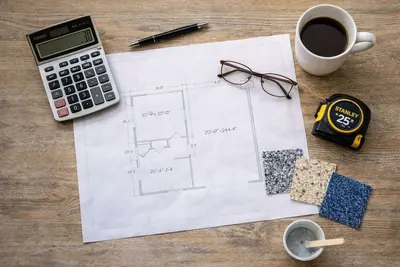
We measure the garage, check the slab and the door edge, and price the whole system in person at no charge.
Cause 1: A Surface the Coating Couldn't Grip
A coating is only as strong as its bond to the concrete. A bare garage slab carries a weak, dusty top layer, plus oil drips, tire marks and sometimes an old sealer. Roll a coating over that and it grips the dust and grime, not solid concrete. It may hold while the floor stays dry, then let go where water and traffic work on it.
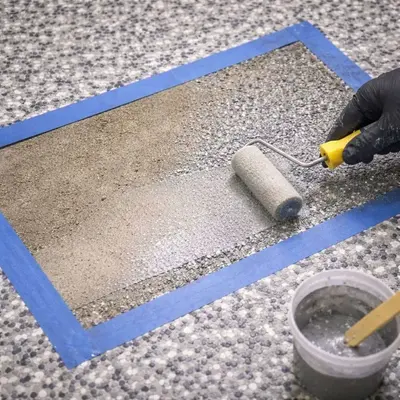
Many store-bought kits prepare the floor with a wash or an acid etch. That is light prep: it won't lift a sealer or a soaked-in stain, and it adds water to a slab that then has to dry. Grinding or sanding removes the weak layer so the coating bonds to sound concrete. Cracks, holes and divots get filled at the same stage, since each one is an edge where water can creep underneath later.
That is the order we work in: concrete ground smooth, then cracks, holes and divots filled, before any coat goes down. Krystal & Til mentioned it in a Google review of their basement laundry room: “…They even ground down imperfections and sealed cracks.”
Cause 2: Hot Tires and a System Not Built for Cars
Tires come off the road hot. Park them on a thin or under-cured coating and the warm rubber softens the surface; as the tire cools, it can grab the coating and pull it up. This is hot-tire pickup, and it shows up wherever the tires sit while they cool.
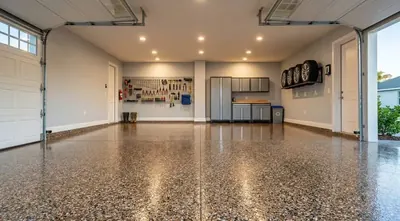
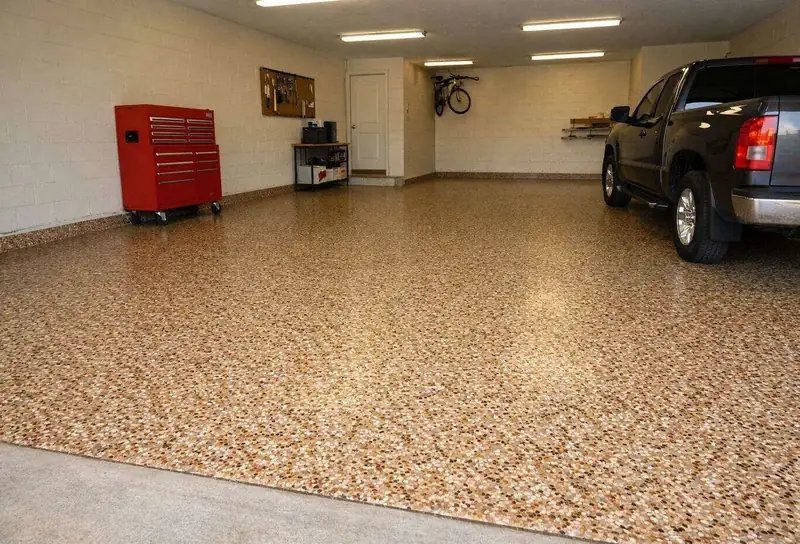
Thin, single-coat products are the most prone to it, and so is any floor driven on before it finished curing. A garage needs a system made for vehicles: a base coat, a flake or color layer, and a top coat chosen for the job (how those layers work together). We install epoxy and also offer polyaspartic and polyurea coatings, and we'll talk through which suits a salted, driven-on floor. Get the walk-on and drive-on times for your system from us, and wait them out. Our epoxy vs. polyaspartic guide compares the options.
Cause 3: Water and Brine, From Above and Below
From above, winter supplies the brine. In 2016 KYTC dedicated three trucks to the six-mile stretch of I-75 between Buttermilk Pike and the Brent Spence Bridge, a stretch that includes the Cut in the Hill, and the City of Cincinnati goes after its hills and bridges first whenever snow is coming. Wheel wells come home packed with salty slush that melts down the slope toward your door.
What lifts a coating is usually water getting underneath it. NRMCA, the concrete industry group, explains that de-icers leave concrete more saturated and add freeze-thaw cycles. Brine that finds a chip, a raw edge or an unfilled crack seeps under the coating. On a cold night it can freeze there (CVG averages about 100 nights a year at or below 32°F), then thaw, prying the edge up a little more with each round.
From below, some slabs carry moisture of their own, and moisture pushing up under a coating can slowly cost it its grip. That's why we look at the slab's moisture before we settle on a system with you. Where readings are high, the usual answer is a moisture-mitigation primer under the coating, which adds roughly $1–$3 per square foot (a typical range, not a quote).
Floor Already Lifting at the Door?
We can look at it, tell you whether the slab underneath is sound and whether a repair or a new floor makes more sense, and quote it in person for free.
Get a Free QuoteFive Questions to Ask Before You Sign
Five questions separate a careful quote from a hurried one.
1. “How will you prepare the concrete?”
Listen for grinding or sanding the surface smooth, removing oil stains and old sealers, and filling cracks, holes and divots before the first coat. “We'll clean it really well” is not prep.
2. “Will you check the slab for moisture, and what happens if it's high?”
A good answer covers checking the slab first and a plan for high readings, such as a moisture-mitigation primer, priced up front.
3. “Which system goes on a garage floor, and why that one?”
Expect each layer to be named, with a reason it suits tires and winter slush. If the plan is a single coat, ask how it will hold up where hot tires stop and brine collects.
4. “When can I walk on it, and when can I park on it?”
Cure times depend on the product and the conditions, so a straight answer gives both for the system being quoted. Parking too soon is one of the easiest ways to start a peel.
5. “Can I read the warranty terms before I pay a deposit?”
The answer you want is yes, on paper, for the exact system in the quote. We hand over a written warranty before any deposit; ask us for the warranty terms on the system you choose.
How We Approach a Garage Floor
Here is how one of our jobs runs, step by step, so you can compare other quotes against it.
- A visit in person. We measure the garage, look at the slab and the door edge, and talk through colors and systems before we quote.
- Straight talk about the concrete. We check the slab for moisture and the cracks for movement, and if a crack is still moving we tell you before anything is coated.
- Prep before product. The concrete is ground smooth, and cracks, holes and divots are filled.
- Color mixed for your floor. Flake, metallic or solid color, custom-mixed, with a non-slip additive available.
- Photos along the way. You get before, during and after pictures. As John Vu put it in his review: “…He sent pics throughout the process to keep me informed.”
- Clean-up. The mess leaves with the crew.
Frequently Asked Questions
Why does my garage floor coating peel at the door first?
Because the door edge takes the most water, brine, heat and traffic. Garage slabs are built to slope toward a drain or the door, so in a garage without a drain the melt ends up at the door, and that strip also sees sun, cold air and hot tires. Any weakness in prep or product shows up there before anywhere else.
Is road salt what makes epoxy peel?
Salt plays a part, but water getting under the coating does the lifting. Brine that reaches a chip, an open edge or an unfilled crack freezes and thaws beneath the coating and pries it up. A well-bonded coating on properly prepared concrete keeps the slush on top, where it can be squeegeed out.
What is hot-tire pickup?
It's when a warm tire softens a coating and pulls it loose as the tire cools. Thin or under-cured coatings are the most prone, which is why a garage needs a system built for vehicles and why it pays to wait out the drive-on time we give you.
Can a peeling floor be repaired?
Often, if the concrete underneath is sound. A repair usually means removing the loose coating, grinding back to a firm edge, filling cracks and recoating. If a crack is still moving, we will say so before anything is coated, and we can quote the fix after seeing the floor.
Get the Door Edge Looked At
Whether your floor is already lifting or you're comparing quotes for a new one, We'll come out, look at the slab and quote it in person at no charge, anywhere in our 13 towns across Greater Cincinnati and Northern Kentucky.
Phone (513) 434-8103 on weekdays from 9 to 6, or ask for a free quote online. For price ranges, see our cost guide; for the weather side of the story, read how Cincinnati's climate affects epoxy floors. Still weighing paint, a kit or a full system? Our garage floor coating guide compares them.