A coated floor in a business does a different job from one in a garage at home (that one has its own garage floor coating guide). It takes carts, pallet jacks or kitchen spills day after day, it has to clean up fast, and putting it down has to fit around the hours the business keeps. The right system follows from what the floor goes through.
Alongside garages and basements, we quote commercial and warehouse floors, and the rule is the same: grind the concrete smooth and repair it before anything is coated. Below are the main systems, local conditions, national price ranges and ways to keep downtime short. What we install, and how a job runs, is on our commercial epoxy flooring in Cincinnati page.
Why Businesses Coat Their Floors
Bare concrete dusts, stains and soaks up spills. A resin coating turns it into a sealed, continuous surface, and that pays off in several ways.
- Faster cleaning. No grout lines or open pores, so spills wipe up instead of soaking in.
- Less dust. A sealed slab stops shedding fine concrete dust onto stock and equipment.
- Grip where it's needed. A non-slip additive or broadcast aggregate adds texture to kitchens, walkways and entries.
- Resistance to spills. The right system holds up to oils, fluids and cleaners that stain raw concrete. Resistance varies by system, so tell the installer what gets spilled.
- Light and order. A light, glossy floor brightens a stockroom, and contrasting colors can mark lanes and work zones.
Need a price for your own space?
We walk the floor, look at the concrete and quote the job in person, free of charge.
Matching the System to the Work
The air-cargo hubs at the Northern Kentucky airport and the aerospace and auto plants north of the city keep a wide ring of suppliers, shops and warehouses busy. This section is for them, and for restaurants, taprooms and offices.
From our own jobs See all 36 photos →
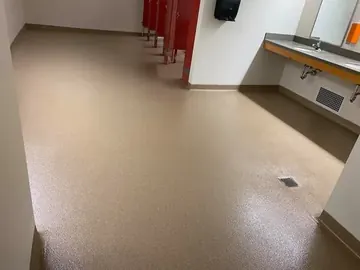
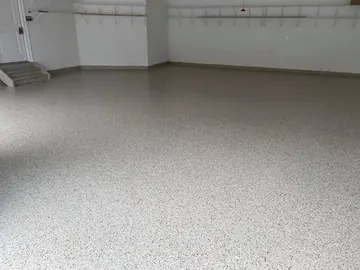
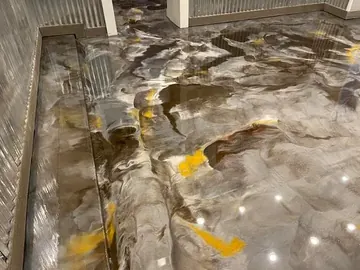
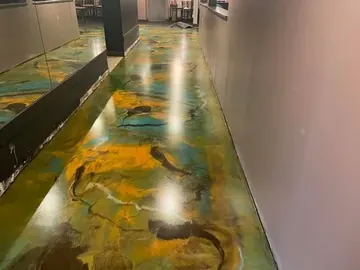
Warehouses and flex space
Flex buildings and warehouses near I-71, I-75 and the I-275 loop carry forklifts, pallet jacks and constant grit. They need a thick, hard-wearing build more than a decorative one: a high-build epoxy, often in a solid color with marked lanes, with a tougher top coat on the busiest aisles. Cracks and holes get filled first. More on industrial epoxy flooring for warehouses and shop floors.
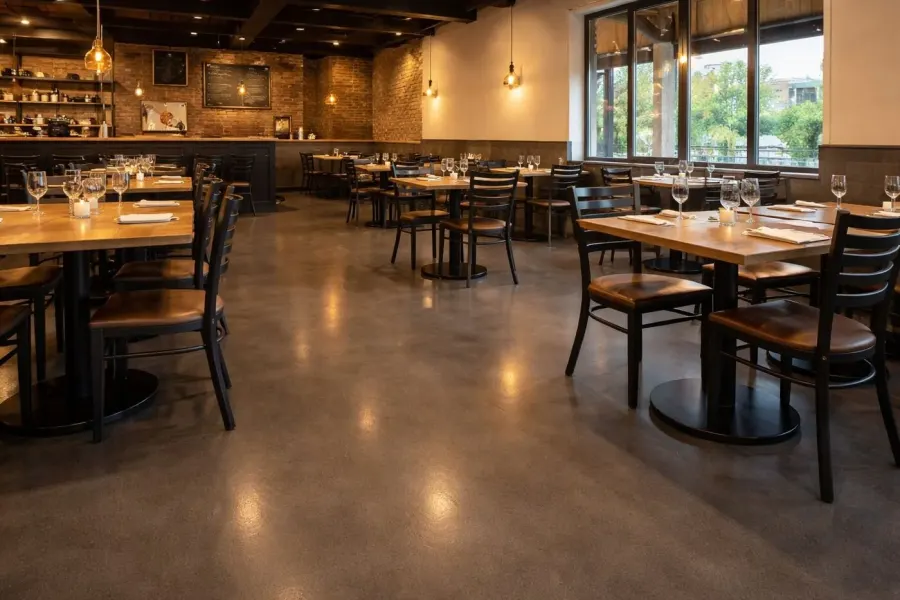
Restaurants, commissaries and taprooms
Kitchen floors take standing water, grease, hot wash-downs and heavy traffic in the same shift. They want a seamless, textured surface, ideally carried a few inches up the wall as a cove base. Inside city limits, restaurants answer to the Cincinnati Health Department; outside the city it is usually the county health department, such as Hamilton County Public Health. Ask your inspector what they expect first.
Brewing runs deep here: by 1860 Cincinnati had as many as 36 breweries, and Visit Cincy reports the region's count has passed its pre-Prohibition total. Brewhouse floors see water, heat and cleaning chemicals daily, and the heaviest hot wash-down zones usually call for urethane mortar, a system we do not install; we will tell you at the walk-through if part of your floor needs it. Taprooms, tasting rooms and back hallways are where our flake, metallic and solid-color floors fit.
Showrooms, offices and gyms
These spaces want a floor that looks finished and stays that way under foot traffic and fixtures. Flake hides daily grit; metallic gives a showroom polish. Think of Blue Ash's office and flex buildings, or the hotels and restaurants on Chester Road in Sharonville.
Service bays and dealerships
Service bays deal with oil, brake fluid, coolant, road salt and hot tires. A hot tire can soften a weak coating and lift it when the car pulls away, so these floors need proper prep and a hard top coat.
Medical, dental and veterinary offices
Clinics and animal hospitals need floors that take strong disinfectants and clean fast between patients. A seamless coating with a cove base leaves fewer places for dirt to collect.
Systems Side by Side
A starting point, not a spec; the slab decides the final system.
| System | Where it fits | Worth knowing | Published range* |
|---|---|---|---|
| Standard epoxy, two coats | Storage, light back rooms | Lowest cost; thin, so it wears faster under traffic | $3 – $5 |
| High-build epoxy | Warehouses, shops | Thick and impact-tolerant; slower cure | $5 – $8 |
| Polyaspartic or polyurea | Floors that must reopen fast; sunny or salted entries | Fast cure, holds color; short working time | $5 – $12 |
| Decorative flake | Retail, showrooms, kitchens | Texture that hides wear | $5 – $9 |
| Metallic epoxy | Showrooms, lobbies, taprooms | Striking look; shows scratches; add non-slip where wet | $6 – $12 |
| Urethane mortar | Kitchens, breweries, wash-down areas | Handles heat and heavy wash-downs | $8 – $15 |
*Per square foot; not Cincinnati prices. From a coatings contractor's 2026 list for the Southeast (aicoat), so treat them as a national order of magnitude. HomeAdvisor puts commercial-grade 100% solids systems at $12 or more per square foot. Of these, we offer solid, flake and metallic epoxy, plus polyaspartic and polyurea.
Floor Studio includes shop and warehouse sizes. Pick one, choose a finish and colors, and see a typical range.
Open Floor Studio →What's Different Around Cincinnati
The chemistry is the same everywhere; the conditions are not.
Salt and slush at entries and docks
By NOAA's 1991–2020 normals, the airport weather station logs roughly 100 freezing nights and 23.3 inches of snow in a typical year. Road crews on both sides of the river use brine and salt, which comes indoors on tires, pallets and boots, so entries and dock aprons take the worst of it. Concrete engineers advise rinsing salt off slabs; on a coated floor that is a squeegee job. Flaking concrete gets ground back and patched first.
Humid summers, cold slabs
Summers here are humid, and a cool slab in a humid building can collect condensation that stops a coating bonding. In winter an unheated warehouse slab can be too cold for standard epoxy; faster polyaspartic and polyurea products tolerate a cooler slab. So install dates can move with the weather.
Old slabs and moving ground
Older slabs carry patches, old paint and oil stains that have to be ground off before a new system will bond. On hillside sites the ground matters too: the Ohio and Kentucky geological surveys describe clay-rich soil over Kope Formation shale, and some soils swell and shrink between wet and dry spells. A coating won't stop a moving slab, so we check cracks for movement and say so before coating.
Cost, With National Ranges
We found no published Cincinnati prices for commercial floors. The out-of-state list above puts most systems between about $3 and $15 per square foot, and a 10,000 sq ft warehouse in high-build epoxy at roughly $50,000 to $80,000. Four things set your number:
- Size. Setup and crew time spread over more floor on a big job, so the price per foot usually drops.
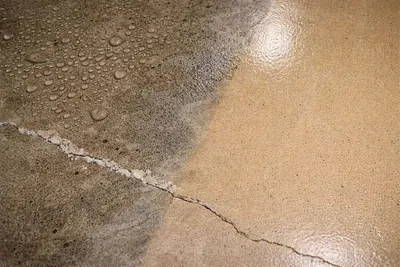
- The slab. Old coatings, oil-soaked concrete, cracks and moisture all add prep. National residential guides put crack patching at about $25 to $250 and moisture testing at about $50 to $300.
- The system. Plain epoxy in a storeroom sits low; urethane mortar in a kitchen or brewhouse sits high.
- Timing. Phased work, or work fitted around opening hours, takes more planning.
Our cost guide has the residential ranges.
Get Your Space Measured
Tell us what the floor goes through and when you can spare it. We come out, measure, check the slab and price the job at no charge.
Keeping Downtime Short
For many businesses the coating is the smaller cost; the bigger one is the days the space can't be used.
Plan the sequence
Ask whether the floor can be done in sections so part of the space keeps working, and when each section can take feet, carts and forklifts again. Clear stock ahead of time, because the floor has to be empty for grinding, and agree how dust and odor will be handled.
Pick the chemistry for the calendar
Fast-curing polyaspartic and polyurea top coats bring a floor back into use sooner than an all-epoxy build. Return-to-service times depend on the product, the coats and the conditions, so get them from us before you set dates. On getting a job scheduled, Logan Sterchi wrote:
“Nick did a fantastic job. He was very professional and able to get us in fast and took care of business. The floor is absolutely beautiful. We couldn't be happier.”
Logan Sterchi, Google review
Frequently Asked Questions
How much does commercial epoxy flooring cost?
Published out-of-state figures put most systems between about $3 and $15 per square foot: roughly $3 to $5 for two-coat epoxy, $5 to $8 for high-build epoxy, $5 to $12 for polyaspartic or polyurea and $8 to $15 for urethane mortar. They are not Cincinnati quotes; we quote after measuring the space.
Which system suits a restaurant kitchen?
A seamless floor with real texture for grip and, ideally, a cove base at the wall. Textured flake systems are common. Heavy hot wash-downs usually call for urethane mortar, which we do not install, so we will tell you at the walk-through whether your kitchen needs a different floor. Check what your inspector expects: the Cincinnati Health Department inside the city, and outside it usually the county health department, such as Hamilton County Public Health.
What works for a warehouse with forklifts?
A thick, high-build epoxy is the usual base, often in a solid color with marked lanes and a harder top coat on the busiest aisles. Cracks and holes are filled first, and we check whether cracks are still moving before anything is coated.
Do you serve businesses in Northern Kentucky?
Yes. Along with Cincinnati and the Ohio suburbs, we cover Florence, Erlanger, Newport and Fort Thomas, and quote commercial floors in person on both sides of the river.